

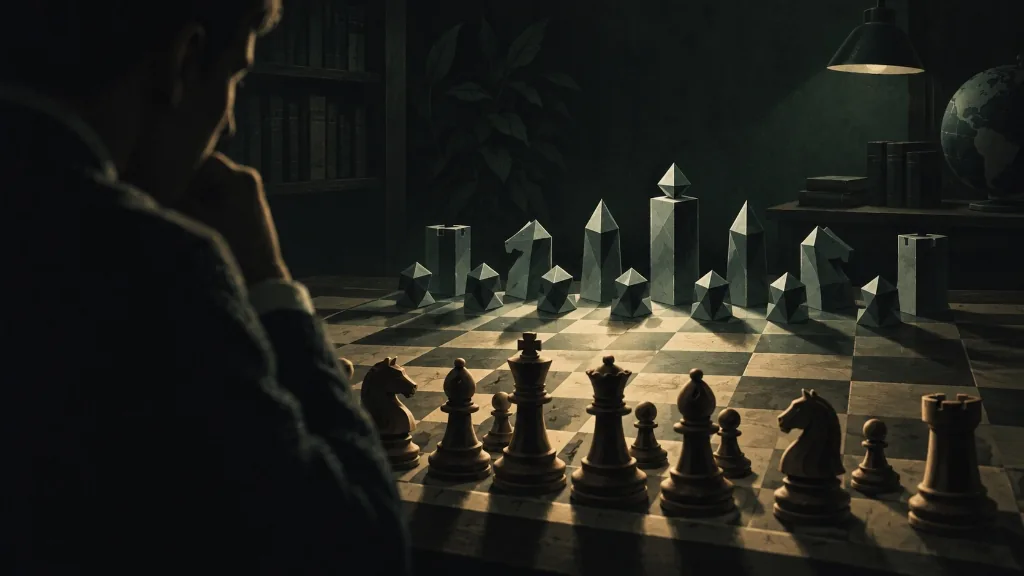
Here is the puzzle the engine era set on the table: the machine's knowledge is nearly perfect, yet knowledge transfer to the human beside it is demonstrably imperfect. Part 1 showed that access works — and that it comes with a substitution cost. To explain both halves, you have to open the learner's head and look at what skill is actually made of.
The pattern libraryExpertise is a library, not a search engine
The foundational experiments of chess psychology — Chase and Simon's in 1973, refined by Gobet and Simon — showed what a master actually is. Give a master and a novice five seconds to memorize a real middlegame position, and the master reconstructs it almost perfectly while the novice scatters pieces. Now scramble the pieces randomly, breaking every chess relationship, and the master's advantage mostly evaporates. The master's gift is not memory; it is a vast organized library of meaningful configurations — chunks — that only exist when the position is real.
This is the mechanism everything else hangs on. Skill is not access to correct answers; it is a retrievable store of patterns, candidate-move generators, and learned cues. And here is where the engine's output falls short as instruction: +2.4 and a principal variation establishes that a move works. It does not, by itself, install the perceptual cue — the loose piece, the overloaded defender, the weakening pawn break — that would make a human notice the idea in a future game. An answer you didn't work for is a fact about the position, not a change in you.
Used well, an engine can stock that library faster than any previous training technology — thousands of accurately evaluated patterns on demand. Used lazily, it replaces library-building with line-reading. Same tool, opposite outcomes; the variable is what the learner does before the evaluation appears.
Effort earns its keepDeliberation is the workout
The evidence that thinking itself is the active ingredient is unusually direct. Moxley and colleagues gave players of different strengths tactical positions and compared their snap decisions with their decisions after further deliberation. Everyone improved by thinking longer — experts and weaker players alike. The cognitive operation that engine-first study skips — generating candidates, holding variations, weighing evaluations — is precisely the operation that makes you better.
Charness and colleagues' deliberate-practice research closes the loop at the career scale: in large samples of tournament players, serious solitary study — not lessons, not even tournament play — was the strongest single predictor of rating. Grandmasters reported dramatically more of it across their development. Whatever engines change, they had better not change that.
This produces the sharpest conceptual tool in this series: performance with assistance and learning from assistance are different outcomes. An engine can make tonight's analysis flawless while removing exactly the cognitive work that was supposed to make you stronger. GM Jan Markos put the coaching intuition bluntly in Under the Surface: "Engines greatly simplify the lives of chess players, but at the same time they make the players more stupid! Today many players prefer to turn the engine on, rather than calculating with their own heads."
"Weak human + machine + better process was superior to a strong computer alone and, more remarkably, superior to a strong human + machine + inferior process." — Garry Kasparov, on the 2005 freestyle tournament won by two amateurs
Kasparov's famous observation — after two club players beat grandmaster-led teams in the 2005 PAL/CSS freestyle event — is usually quoted as a parable about teamwork. In the study room it is more pointed: process was the winning variable, not machine strength. The strongest engine attached to a weak process loses to a weaker engine attached to a good one.
The load problemOne number is not a lesson
A subtle finding from educational psychology sharpens the picture further. De Bruin, Rikers and Schmidt studied novices learning a chess endgame and found that requiring them to select material for restudy improved their results — but asking them to make extra "judgments of learning" did not improve performance and appeared to waste their limited working memory. For a novice, every unit of attention spent on self-monitoring is a unit stolen from the task itself.
Translate that to the modern interface and it explains a common failure. An engine hands a beginner an evaluation number, three principal variations, a depth counter, an accuracy score, and an opening label — a firehose of information with no pedagogy attached. "−3.2" is not a lesson. "Your undefended bishop allowed a discovered attack" is a lesson. The engine supplies objective diagnosis; something has to decide which slice of that diagnosis is teachable right now — a coach, a good interface, or a student with the discipline to ask one question at a time.
This is also why the newest engine research is pedagogically interesting. The Maia project — from Microsoft Research, Cornell, and Toronto — trained neural networks not to play the best move but to predict what a human of a given rating would play, blunders included. It turns out superhuman engines are poor models of human choices; Maia is far better. A sparring partner that errs the way a 1500 errs may eventually teach more than an oracle that never errs at all. Research on "skill-compatible AI" reaches the same conclusion from the other side: maximum strength and usefulness as a partner are separate design targets. That promise, for now, remains a research direction rather than a proven learning gain.
The creativity questionDo engines flatten or widen imagination?
The pessimists' case writes itself: everyone checks the same top lines, opening preparation converges, and a generation learns to think "like the computer." There is visible evidence for the convergence half — top-level opening repertoires have undeniably homogenized around engine-approved lines, and every elite camp now has to un-book opponents who memorized the same file.
But the best empirical evidence we have points the other way. Shin and colleagues analysed 5.8 million professional Go decisions from 1950–2021 in a landmark PNAS study, using a superhuman AI to generate 58 billion counterfactual continuations. After AlphaGo, human professionals played both better and more novel moves — decisions never seen in recorded history — and novelty became more associated with quality, not less. The machine didn't flatten human strategy; it expanded the frontier of what humans dared to try.
Chess shows the same qualitative signature. AlphaZero's published games startled the elite with long-term piece sacrifices and h-pawn storms that violated inherited dogma — then got absorbed into human repertoires within a few years. Both processes coexist: engines narrow the consensus around established positions while widening the space of what counts as playable elsewhere. Whether your own imagination grows or shrinks depends on which of those you consume — a memorized verdict, or a new idea you had to chase down.
The honest verdict on lazinessOverreliance, without the moral panic
Time for precision, because this is where coaching folklore outruns science. The claim that engines "destroy calculation" is plausible — skills you outsource don't get trained — and Part 1 documented one real substitution cost: less practice exploiting human error. But this review found no well-powered trial in which comparable players were assigned engine-first versus human-first study for months and then tested unassisted. "Engines make you lazy" is a hypothesis about training design, not an established finding.
What the evidence does support is a cleaner distinction: replacement use versus feedback use. Replacement use asks the machine to perform the operation you're trying to learn — "what's the move, what's the evaluation?" Feedback use performs it yourself first and spends the machine on verification. One arrangement deletes the exercise; the other audits it. Nearly every sensible coaching protocol — including the one in Part 3 — is just this distinction operationalized.
One more honest caveat belongs on the ledger: the eval bar is a harsh emotional reference point. A player can win an excellent game and then watch the machine flag twenty "inaccuracies." Whether that produces perfectionism and lost enjoyment is unproven — controlled wellbeing research here simply doesn't exist — but the coaching advice to record what you did right alongside the errors is cheap insurance. The engine's scoreboard measures decisions; it was never designed to measure you.
So the mechanism, in one sentence: an engine is a superb verification instrument attached to no pedagogy at all — and whether it builds your pattern library or replaces it is decided by the order of operations you choose. Part 3 turns that into a working protocol.
Sources for this part
- Chase, W. G., & Simon, H. A. (1973) — "Perception in chess," Cognitive Psychology 4(1); Gobet, F., & Simon, H. A. (1996) — "Recall of random and distorted chess positions," Memory & Cognition 24.
- Moxley, J. H., Ericsson, K. A., Charness, N., & Krampe, R. T. (2012) — "The role of intuition and deliberative thinking in experts' superior tactical decision making," Cognition 124(1).
- Charness, N., Tuffiash, M., Krampe, R., Reingold, E., & Vasyukova, E. (2005) — "The role of deliberate practice in chess expertise," Applied Cognitive Psychology 19(2).
- de Bruin, A. B. H., Rikers, R. M. J. P., & Schmidt, H. G. (2005) — "Monitoring accuracy and self-regulation when learning to play a chess endgame," Applied Cognitive Psychology 19(2).
- Shin, M., Kim, J., van Opheusden, B., & Griffiths, T. L. (2023) — "Superhuman artificial intelligence can improve human decision-making by increasing novelty," PNAS 120(12).
- McIlroy-Young, R., Sen, S., Kleinberg, J., & Anderson, A. (2020) — "Aligning Superhuman AI with Human Behavior: Chess as a Model System" (Maia), KDD.
- Kasparov, G. (2010) — "The Chess Master and the Computer," The New York Review of Books.
- Silver, D., et al. (2018) — "A general reinforcement learning algorithm that masters chess, shogi, and Go through self-play," Science 362(6419).
- Markos, J. (2018) — Under the Surface (Quality Chess), on engine dependence in modern players.