

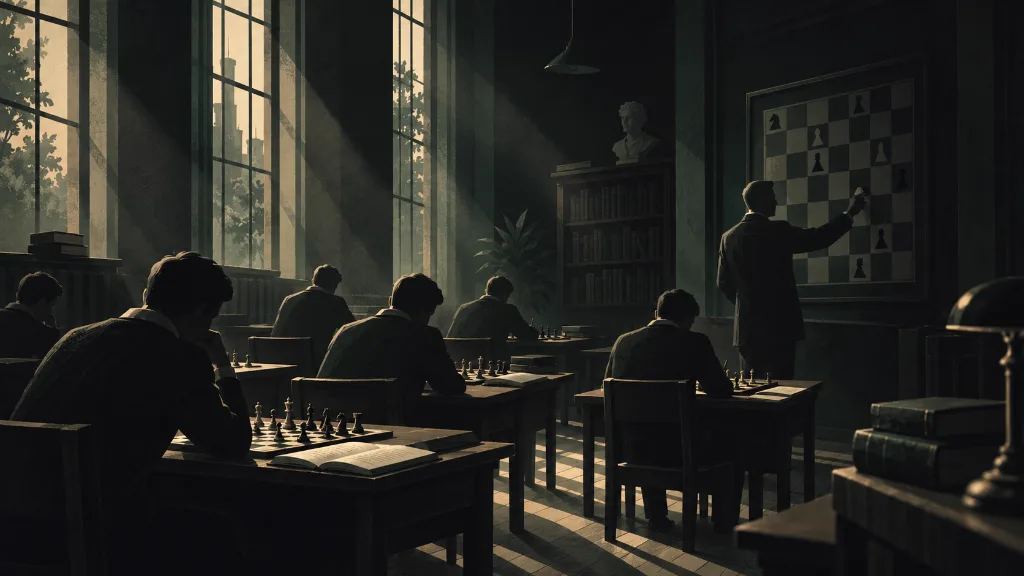
Every serious national chess program on earth is either descended from the Soviet model or defined in opposition to it. What the USSR built between 1920 and 1990 remains the most successful talent-development system in the history of the game — and its habits still shape how every elite player trains today.
The state adopts the gameChess to the masses
After the 1917 revolution, chess was recast from a bourgeois pastime into an instrument of the state. In 1920, chess master and Bolshevik administrator Alexander Ilyin-Zhenevsky folded chess into Vsevobuch, the universal military-training system — reasoning that the calculation, discipline, and decision-making it demanded were the same qualities wanted in soldiers and party cadres. By 1924, the All-Union Chess and Checkers Congress, driven by prosecutor Nikolai Krylenko, had centralized the game under a single national organization.
The slogan of the era was "chess to the masses," and it was meant literally: chess sections appeared in workers' clubs, trade unions, schools, military units, and village reading rooms. Chess was recast as public culture — cheap, teachable, and administrable. A wooden board in a workers' club became a node in a national network.
The pipelineFrom school clubs to stipends
The result was a pipeline with no equivalent in the world. Children were spotted in school clubs and Pioneers' palaces, fed into a graded tournament system with formal categories and norms, and — if they kept winning — supported with stipends, trainers, and places in sports schools. Elite players became professionals in the literal sense: chess was a career the state paid for.
The competitive density was self-reinforcing. Because millions played and thousands played seriously, a rising junior faced strong opposition constantly — championship qualifiers, trade-union tournaments, team leagues — without ever leaving the country.
The methodBotvinnik turns chess into a discipline
At the top sat Mikhail Botvinnik, world champion for most of 1948–1963, whose real contribution was not a style of play but a method: chess treated as a sport and a science rather than an art. Soviet journalists liked to describe a dashing national style; the deeper truth was a training culture — rigorous, documented, and ruthlessly objective.
"Botvinnik's example and teaching established the modern approach to preparing for competitive chess: regular but moderate physical exercise; analysing very thoroughly a relatively narrow repertoire of openings; annotating one's own games… publishing one's annotations so that others can point out any errors; studying strong opponents… ruthless objectivity about one's own strengths and weaknesses." — Vladimir Kramnik, on the Botvinnik school
Botvinnik's method
The training habits the school codified — still the professional standard.
- Physical conditioning, kept regular but moderate
- A narrow opening repertoire, analysed very deeply
- Annotate your own games, thoroughly
- Publish the annotations and invite criticism
- Study opponents and their habits
- Be ruthlessly objective about your own play
The Botvinnik school — later the Botvinnik-Kasparov school — trained Karpov, Kasparov, and Kramnik. Its habits (deep opening files, self-annotation, physical conditioning, opponent dossiers, elite seconds) became the professional standard everywhere. The payoff was staggering: Soviet players held the world championship almost without interruption from 1948 to 2000, and the USSR won 18 of the 19 Olympiads it entered between 1952 and 1990.
Why it worked
- Massive base. Millions played in clubs and schools, so talent surfaced early and in volume.
- A method, not a mystique. Training was systematic: categories, norms, annotated games, preparation files.
- Chess was a career. Stipends, trainers, travel, and prestige made elite play a viable profession.
- Depth at the top. The elite trained with each other — the seconds and sparring partners of a Soviet champion were themselves world-class.
The afterlifeThe machine is dismantled; the parts go everywhere
The model's afterlife matters as much as its peak. After 1991, thousands of Soviet-trained coaches emigrated — to the United States, Western Europe, Israel, India, and beyond — seeding their methods into every chess culture that hired them. When Viswanathan Anand later built an academy for India's best juniors, he explicitly modeled it on the Botvinnik school and staffed it partly with its products.
Russia still fields the deepest pool of grandmasters on earth, but the monopoly is gone — exported, ironically, by the school's own graduates. The rest of this series is the story of what other countries did with it.
Sources for this part
- Wikipedia — Soviet chess school.
- Chess.com — "The Biggest Secret of the Soviet Chess School" (Kramnik on the Botvinnik method).
- Soviet Chess History — "Chess to the Masses."
- Kritika (Slavica) — "Valedictorians of the Soviet School: Professionalization and the Impact of War in Soviet Chess."